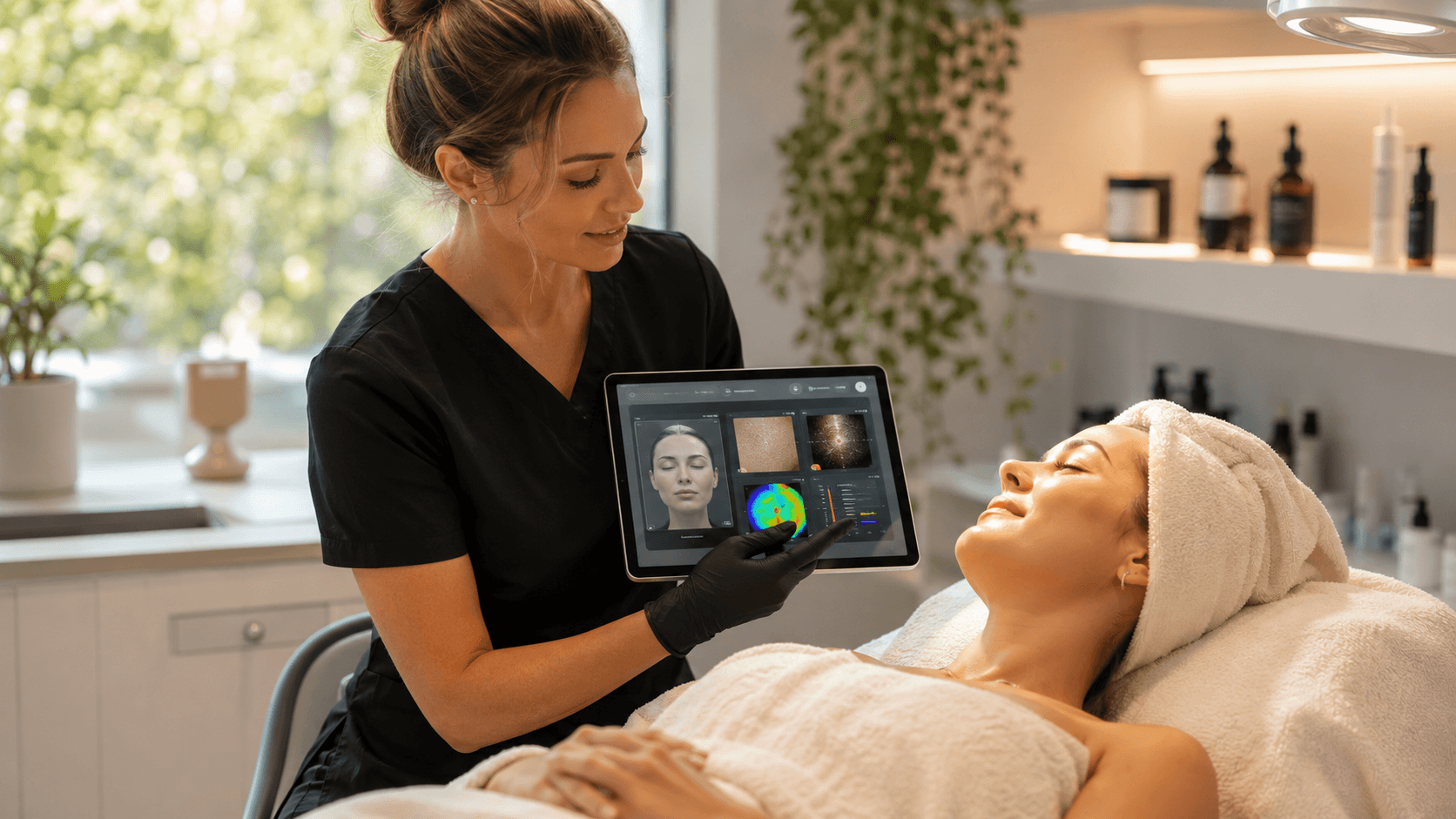
If you searched "AI esthetician," you are probably looking for one of two things: AI tools that help estheticians run smarter practices, or clarity on what AI can actually do in a treatment room without replacing professional judgment.
Both matter — and both are changing fast in 2026.
Estheticians are adopting AI not to automate facials, but to handle everything around the facial: consultations, booking, intake, treatment planning, client follow-up, rebooking, marketing, and the admin work that steals hours from the chair every week.
This guide explains what an AI esthetician workflow looks like in practice — from skin analysis support to smart scheduling — and how to choose tools built for esthetics, not generic business software.
What "AI Esthetician" Actually Means
There is no robot giving facials — and there should not be.
"AI esthetician" refers to the AI-powered systems that support licensed estheticians throughout their business: analyzing skin data, drafting treatment plans, managing bookings, tracking client history, generating aftercare, and keeping clients on consistent care schedules.
Think of it as an intelligent back office and consultation assistant — not a replacement for your hands, your license, or your clinical eye.
What AI esthetician tools do:
- Support skin consultations with structured analysis and documentation
- Automate booking, reminders, and rebooking outreach
- Generate treatment protocols and personalized aftercare
- Manage client records, photos, and progress over time
- Handle intake forms, contraindications, and consent digitally
- Draft marketing content, emails, and social posts in your voice
- Surface insights like who is overdue for a visit or ready for an upgrade
What they do not do:
- Diagnose medical conditions (that stays with physicians and licensed providers within scope)
- Replace your professional assessment during a live treatment
- Remove the need for patch tests, contraindication review, or informed consent
- Make clinical decisions without your oversight
The estheticians winning with AI in 2026 use it to show up more prepared, communicate more consistently, and retain clients longer — while staying fully in control of every treatment decision.
AI Skin Analysis and Consultation Support
One of the fastest-growing areas of beauty AI is skin analysis — tools that help estheticians assess, document, and explain skin conditions during consultations.
Clients arrive with more questions than ever. They have seen skin analysis devices on social media, read about ingredients online, and want data-backed recommendations — not vague product pitches.
What AI Skin Analysis Can Do
Structured consultation support:
- Organize observations by concern: dehydration, congestion, pigmentation, sensitivity, aging
- Document skin type, texture, and current routine
- Track changes visit over visit with photos and notes
- Generate consultation summaries clients can understand
- Support treatment recommendations with clear rationale
Visual documentation:
- Before-and-after photo organization
- Progress tracking across a facial series
- Side-by-side comparisons for client education
- Portfolio content for marketing (with permission)
Content and education:
- Explain skin concerns in plain language for clients
- Generate aftercare instructions customized to the service performed
- Create educational social posts about common skin issues
- Research ingredient interactions and product compatibility
What to Watch Out For
AI skin analysis is a support tool, not a medical diagnostic device unless you are using FDA-cleared equipment within its intended scope. Always frame results as professional assessment supported by technology — not as a definitive medical diagnosis.
The estheticians who use skin analysis well combine technology with touch, conversation, and professional experience. The analysis gives structure. You provide context, empathy, and the treatment plan.
This connects directly to skincare treatment trends in 2026 — clients want consultation-first, analysis-guided services, not one-size-fits-all facials.
AI Receptionist and Booking for Estheticians
If you are a solo esthetician or run a small spa, you are also the front desk. And front desk work does not stop when you are mid-facial.
AI receptionist and booking tools help estheticians:
Answer inquiries faster:
- Service descriptions and pricing questions
- Availability and booking policies
- Contraindication pre-screening before booking
- Product and aftercare questions between visits
Book appointments 24/7:
- Online scheduling when clients are ready — often late at night
- Automated confirmation and reminder texts
- Deposit collection for high-value services
- Waitlist management when slots open up
Reduce no-shows:
- Timed SMS and email reminders
- Clear cancellation policy communication
- Rebooking prompts for clients who miss their window
No-shows cost estheticians thousands per year. An esthetician charging $120 per service who eliminates two no-shows per week saves over $12,000 annually. AI booking pays for itself quickly.
For a deeper dive on reception and booking automation in beauty, see our guide on AI receptionist and booking assistants for makeup artists — the same principles apply to esthetics practices.
AI Treatment Planning and Protocol Generation
Every experienced esthetician has treatment knowledge in their head — which peel suits which skin, how to sequence a series, what to do when a client reacts to a product. AI helps turn that expertise into repeatable, documented protocols you can use consistently across clients and staff.
What AI Treatment Planning Supports
Customized facial protocols:
- Generate step-by-step treatment plans for specific concerns
- Adjust protocols based on contraindications from intake forms
- Create series plans (e.g., 4-week acne program, 6-session brightening series)
- Document product usage and timing for each step
Aftercare generation:
- Personalized home care instructions after each service
- Product recommendations based on skin type and treatment performed
- Ingredient warnings when clients are on actives or medications
- Follow-up timing for the next recommended visit
Staff consistency:
- Standardized protocols for multi-provider spas
- Training reference for newer estheticians
- Quality control across treatment rooms
Business development:
- Package ideas based on your menu and margins
- Seasonal promotion concepts tied to skin concerns
- Upsell suggestions based on client history
AI does not invent treatments outside your scope or training. It organizes and accelerates the planning you already do — so every client gets the same level of thoughtful preparation, whether it is your first appointment of the day or your last.
AI-Powered Client Records and Retention
The estheticians with the fullest books are not always the best marketers. They are the ones who remember — skin history, product reactions, life events, preferences, and visit cadence.
AI-enhanced client management makes that memory scalable.
Smart Client Profiles
Everything in one place:
- Contact info, skin type, allergies, medications
- Treatment history with dates, services, and outcomes
- Product purchases and home routine notes
- Photos and progress documentation
- Personal details that build relationship (with appropriate boundaries)
Retention Intelligence
AI can analyze visit patterns and surface actions:
- "Lisa hasn't been in for 8 weeks — she usually comes every 4."
- "Three clients who had chemical peels are due for their next session."
- "Maria's birthday is next week — send a personal note?"
- "Clients who booked barrier-repair facials often rebook within 5 weeks."
These prompts turn client retention from something you mean to do into something your system helps you execute.
Rebooking Automation
The gap between a great facial and the next booking is where most estheticians lose revenue. AI-supported follow-up helps:
- Send rebooking reminders at the right interval for each service
- Recommend the next treatment based on the last visit
- Follow up on home care compliance
- Request reviews after positive experiences
Retention is cheaper than acquisition. AI makes consistent follow-up possible even when you are fully booked.
Digital Intake Forms and Compliance
Paper intake forms are a liability. Rushed clients skip questions. Handwriting is illegible. Consent documentation gets lost. And when something goes wrong, incomplete records create real legal exposure.
AI-enhanced digital intake solves this:
AI-assisted form building:
- Generate state-appropriate intake forms for your services in minutes
- Include contraindication screening for peels, microneedling, and advanced services
- Add conditional logic — if a client marks "pregnant," relevant follow-up questions appear automatically
Pre-appointment delivery:
- Clients complete forms before arriving
- More accurate medical history and allergy documentation
- More treatment time, less waiting room paperwork
Integrated records:
- Responses attach directly to client profiles
- Consent timestamps and e-signatures stored securely
- Easy reference during consultation and treatment
We covered this in depth in our digital intake forms guide. For estheticians performing advanced services, proper intake is not optional — it is license protection.
AI Marketing for Estheticians
You cannot fill your book if clients do not know you exist. But most estheticians do not have time for consistent marketing between back-to-back appointments.
AI marketing tools help estheticians:
Social media:
- Write Instagram captions and educational Reels scripts
- Plan content around seasonal skin concerns
- Repurpose one client result into multiple posts
- Maintain posting consistency without nightly caption stress
Email campaigns:
- Promote seasonal services and facial series
- Re-engage lapsed clients
- Announce new treatments or product lines
- Share educational content that builds trust
Local visibility:
- Draft Google Business Profile updates
- Request and respond to reviews professionally
- Create content that supports 5-star reputation building
The estheticians who grow fastest in 2026 combine clinical skill with visible, consistent education — and AI makes that consistency achievable without hiring a marketing team.
AI Esthetician vs. Generic AI Tools
You might already use ChatGPT or Claude for captions and emails. That is a start — but generic AI has limits for esthetics:
| Generic AI (ChatGPT, etc.) | AI Esthetician Platform |
|---|---|
| Blank chat — you provide all context every time | Your services, policies, and clients built in |
| No booking or scheduling | Integrated online booking and reminders |
| No client records | Full CRM with treatment history |
| No intake or consent workflow | Digital forms with e-signatures |
| No rebooking automation | Retention prompts and follow-up sequences |
| You copy/paste between apps | One workflow from inquiry to rebooking |
As we explained in ChatGPT vs. ProBeauty AI, the advantage is not one AI model — it is the beauty workflow layer that connects booking, clients, forms, communication, and AI assistance in one place.
For estheticians tired of juggling five apps, an integrated AI esthetician platform replaces fragmentation with a single system designed for how you actually work.
How to Choose AI Esthetician Software
When evaluating platforms, prioritize:
Esthetics-specific design. The tool should understand facials, peels, contraindications, and treatment series — not require you to explain your industry from scratch.
Booking at the center. Everything connects back to appointments: intake before the visit, notes during, follow-up after, rebooking when due.
Mobile-friendly. You are on your feet all day. If it only works on desktop, you will not use it.
Simple onboarding. You should be booking clients and sending forms within your first session — not sitting through hours of training.
AI that supports, not replaces. You stay in control of every treatment decision. AI handles drafting, organizing, reminding, and suggesting.
Room to grow. Start with booking and forms. Add AI assistants, image tools, and marketing as you are ready.
ProBeauty AI is built for this exact workflow — estheticians, spas, and beauty professionals who want AI assistants, smart booking, client management, intake forms, image templates, and marketing support without managing a scattered tech stack.
How to Get Started as an AI Esthetician
You do not need to automate everything at once. Here is a practical rollout:
Week 1: Booking and Reminders
Set up online scheduling with automated SMS reminders. This alone reduces no-shows and eliminates scheduling DMs.
Week 2: Digital Intake
Create intake forms for your core services. Send them automatically when clients book. Review responses before each appointment.
Week 3: Client Records
Start documenting treatment notes, skin observations, and product recommendations in a digital profile. The database becomes more valuable every month.
Week 4: AI Assistance
Use AI to draft follow-up messages, aftercare instructions, and social content. Start with one task and expand.
Month 2 and Beyond
Add rebooking automation, treatment protocol templates, skin analysis documentation, and email campaigns. Build the full AI esthetician workflow over time — not overnight.
For a broader overview of all five AI tool categories, see 5 AI Tools Every Esthetician Should Be Using in 2026.
The Bottom Line
An AI esthetician is not a machine doing skincare. It is a licensed professional with intelligent systems supporting every part of the business — consultation, booking, treatment planning, documentation, follow-up, and growth.
Clients still choose you for your expertise, your touch, and the trust you build in the treatment room. AI just makes it easier to deliver that experience consistently, at scale, without burning out on admin.
The estheticians adopting AI in 2026 are not less personal. They are more present — because they are not distracted by the scheduling text, the unanswered DM, or the intake form they forgot to send.
You bring the human touch. AI handles the rest.
ProBeauty AI is the AI esthetician platform built for beauty professionals — combining skin consultation support, smart booking, client records, digital intake forms, AI chat, image templates, and marketing tools in one place. Get started free.